

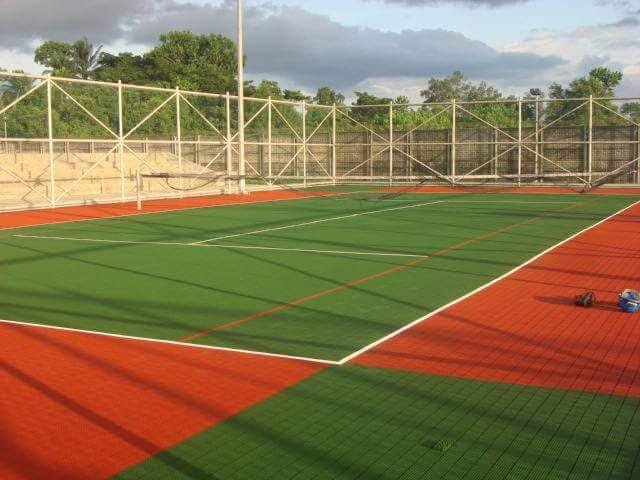
Synthetic Tennis Court vs Other Court Types
Synthetic Tennis Court vs Other Court Types: A Complete Comparison
Tennis court surfaces play a major role in how the game is experienced, how much maintenance is required, and how long the facility lasts. For developers, schools, hotels, and sports clubs—especially in Africa and Nigeria—choosing the right surface is a critical decision that affects cost efficiency, player performance, and long-term durability.
Among all options, synthetic tennis courts (typically synthetic turf or synthetic acrylic systems) are becoming increasingly popular. But how do they compare with other common court types like hard courts, clay courts, and natural grass courts?
This guide provides a clear breakdown.
1. Synthetic Tennis Courts (Artificial / Synthetic Surface)
Synthetic tennis courts are made using engineered materials such as artificial turf or cushioned synthetic layers, designed to mimic natural playing conditions while improving durability.
Key Features:
- Artificial turf or synthetic fiber surface
- Shock-absorbing underlayers (in premium versions)
- Consistent playing surface
- Low water requirement
Advantages:
Low Maintenance
Unlike clay or grass, synthetic courts do not require daily watering, mowing, or resurfacing. Cleaning is simple and periodic brushing or washing is enough.
Weather Resistance
Synthetic courts perform well in:
- Heavy rainfall
- Hot climates
- Dusty environments
This makes them highly suitable for African weather conditions.
Durability
They can withstand heavy usage in schools, hotels, and sports academies without quick deterioration.
Year-Round Playability
Synthetic courts can be used consistently throughout the year with minimal downtime.
Disadvantages:
Surface Feel
Some advanced players feel synthetic courts do not perfectly replicate professional tour-level bounce compared to hard courts or clay.
Heat Retention
In very hot climates, synthetic surfaces can become warm under direct sunlight.
2. Hard Courts (Acrylic / Concrete / Asphalt)
Hard courts are the most common tennis surfaces worldwide, including in Nigeria.
Key Features:
- Concrete or asphalt base
- Acrylic top coating
- Painted boundary lines
Advantages:
Consistent Bounce
Hard courts offer predictable ball behavior, making them ideal for competitive play.
Professional Standard
Many official tournaments use hard courts.
Moderate Maintenance
They require less upkeep than clay but more resurfacing over time compared to synthetic turf.
Disadvantages:
Impact on Joints
Hard surfaces are less forgiving on players’ knees and ankles.
Cracking Risk
Poor drainage or foundation issues can lead to surface cracks.
3. Clay Courts
Clay courts are traditional tennis surfaces widely used in Europe and some parts of Africa.
Key Features:
- Crushed brick or stone surface
- Requires regular watering and rolling
Advantages:
Slower Game Speed
Clay slows down the ball, making rallies longer and improving endurance.
Reduced Injury Risk
The soft surface is easier on joints compared to hard courts.
Disadvantages:
High Maintenance
Clay courts require:
- Daily watering
- Regular rolling
- Frequent leveling
Weather Sensitivity
Heavy rain can render the court unusable for days.
4. Natural Grass Courts
Natural grass courts are the most traditional and prestigious tennis surfaces.
Key Features:
- Natural grass grown on prepared soil base
- Requires advanced irrigation systems
Advantages:
Premium Experience
Grass courts are associated with elite tournaments like Wimbledon.
Fast Gameplay
The ball moves quickly on grass, offering a unique playing style.
Disadvantages:
Very High Maintenance
Requires:
- Constant mowing
- Watering
- Fertilization
- Pest control
Seasonal Usage
Grass courts are highly affected by weather conditions and cannot handle heavy usage.
Direct Comparison Summary
1. Maintenance Level
- Synthetic: Low
- Hard Court: Moderate
- Clay: High
- Grass: Very High
Winner: Synthetic courts
2. Durability
- Synthetic: High
- Hard Court: High (but may crack)
- Clay: Medium
- Grass: Low
Winner: Synthetic courts
3. Player Comfort
- Synthetic: Good cushioning
- Hard Court: Moderate to harsh
- Clay: Excellent
- Grass: Excellent
Best comfort: Clay & Grass
Balanced option: Synthetic
4. Cost of Maintenance (Long-Term)
- Synthetic: Low
- Hard Court: Moderate
- Clay: High
- Grass: Very High
Winner: Synthetic courts
5. Weather Suitability (Africa/Nigeria)
- Synthetic: Excellent
- Hard Court: Good
- Clay: Poor in heavy rain
- Grass: Poor
Winner: Synthetic courts
6. Performance Consistency
- Synthetic: Stable
- Hard Court: Very stable
- Clay: Variable (weather dependent)
- Grass: Highly variable
Winner: Hard & Synthetic courts
Which Court Type Is Best for Africa?
For African climates—especially Nigeria, Ghana, Kenya, and South Africa—synthetic tennis courts and hard courts dominate in practicality and cost efficiency.
However:
- Synthetic courts are best for schools, hotels, estates, and recreational facilities due to low maintenance and durability.
- Hard courts are ideal for competitive training and tournaments.
- Clay and grass courts are mostly suitable for luxury clubs or specialized environments.
Final Conclusion
Synthetic tennis courts offer one of the most balanced solutions for modern sports facility development. They combine durability, low maintenance, weather resistance, and consistent usability—making them especially suitable for Africa’s climate and fast-growing sports infrastructure market.
While traditional surfaces like clay and grass provide unique playing experiences, they come with higher maintenance demands and environmental sensitivity. Hard courts remain the standard for competition, but synthetic systems are quickly becoming the preferred choice for schools, hotels, residential estates, and sports academies.
For developers and investors, the decision ultimately depends on usage goals—but in terms of efficiency, sustainability, and long-term value, synthetic tennis courts are one of the strongest options available today.