

The Complete Guide to Tennis Court Construction in Africa
The Complete Guide to Tennis Court Construction in Africa
Tennis is experiencing steady growth across Africa, driven by increasing participation among schools, universities, private clubs, residential estates, hotels, sports academies, and recreational centers. Countries such as Nigeria, South Africa, Kenya, Egypt, Ghana, and Morocco are witnessing growing demand for quality tennis facilities as interest in professional and recreational tennis continues to expand.
However, building a tennis court involves much more than painting lines on a concrete surface. A properly constructed court requires careful planning, quality materials, effective drainage, and adherence to international standards to ensure durability, safety, and optimal playing performance.
This guide provides a comprehensive overview of tennis court construction in Africa, covering design considerations, surface options, costs, maintenance, and best practices.
Why Invest in a Tennis Court?
Tennis courts offer numerous benefits for:
- Schools and universities
- Sports academies
- Residential estates
- Hotels and resorts
- Recreation centers
- Private sports clubs
Key advantages include:
- Growing popularity of tennis
- Relatively low maintenance compared to football pitches
- Smaller land requirements
- Long lifespan when properly constructed
- Revenue opportunities through memberships, coaching, and court rentals
A well-designed tennis court can serve users for many years while generating consistent income.
Understanding Standard Tennis Court Dimensions
According to international tennis standards:
Court Dimensions
- Length: 23.77 meters
- Singles Width: 8.23 meters
- Doubles Width: 10.97 meters
Recommended Total Playing Area
For comfortable play and safety:
- Length: 36.6 meters
- Width: 18.3 meters
This additional space allows players to move freely beyond the playing lines.
Step 1: Site Selection and Assessment
The success of any tennis court project begins with choosing the right location.
Factors to consider include:
Soil Conditions
Stable soil reduces the risk of:
- Surface cracking
- Settlement issues
- Drainage failures
Accessibility
The court should be easily accessible to users and maintenance teams.
Available Space
Allow room for:
- Spectator seating
- Fencing
- Walkways
- Future expansion
Environmental Conditions
Consider:
- Sun direction
- Wind exposure
- Flooding risks
In Africa’s climate, proper site assessment is essential for long-term durability.
Step 2: Earthworks and Site Preparation
Before construction begins:
- Vegetation is removed
- The site is excavated
- Soil is compacted
- Levels are established
Proper site preparation ensures a stable foundation and minimizes future structural problems.
Step 3: Drainage Design
Drainage is one of the most critical elements of tennis court construction.
Poor drainage can cause:
- Water pooling
- Surface damage
- Cracking
- Reduced court lifespan
Recommended Drainage Systems
Surface Drainage
Uses court slopes to direct water away from the playing area.
Subsurface Drainage
Includes underground drainage pipes that remove excess water beneath the court.
For regions with heavy rainfall, such as Nigeria and much of West Africa, drainage should never be compromised.
Step 4: Constructing the Court Base
The base determines the court’s stability and performance.
A typical base structure includes:
Subgrade
Compacted natural soil.
Sub-Base
Crushed stone or gravel layers.
Base Layer
Concrete or asphalt surface.
The base must be perfectly level and properly compacted to prevent future surface failures.
Step 5: Choosing the Right Tennis Court Surface
The surface significantly affects construction costs, maintenance requirements, and playing characteristics.
Acrylic Hard Courts
The most common choice in Africa.
Advantages
- Affordable
- Durable
- Low maintenance
- Suitable for outdoor conditions
Ideal For
- Schools
- Clubs
- Residential estates
- Sports academies
Clay Courts
Popular in some regions but less common.
Advantages
- Slower gameplay
- Reduced stress on joints
Challenges
- Higher maintenance
- Frequent watering
- Surface grooming requirements
Synthetic Grass Courts
Provide a softer playing experience.
Benefits
- Comfortable surface
- Lower maintenance than clay
Limitations
- Higher installation cost
Cushioned Acrylic Courts
Premium option for professional facilities.
Benefits
- Enhanced comfort
- Reduced injury risk
- Professional playing conditions
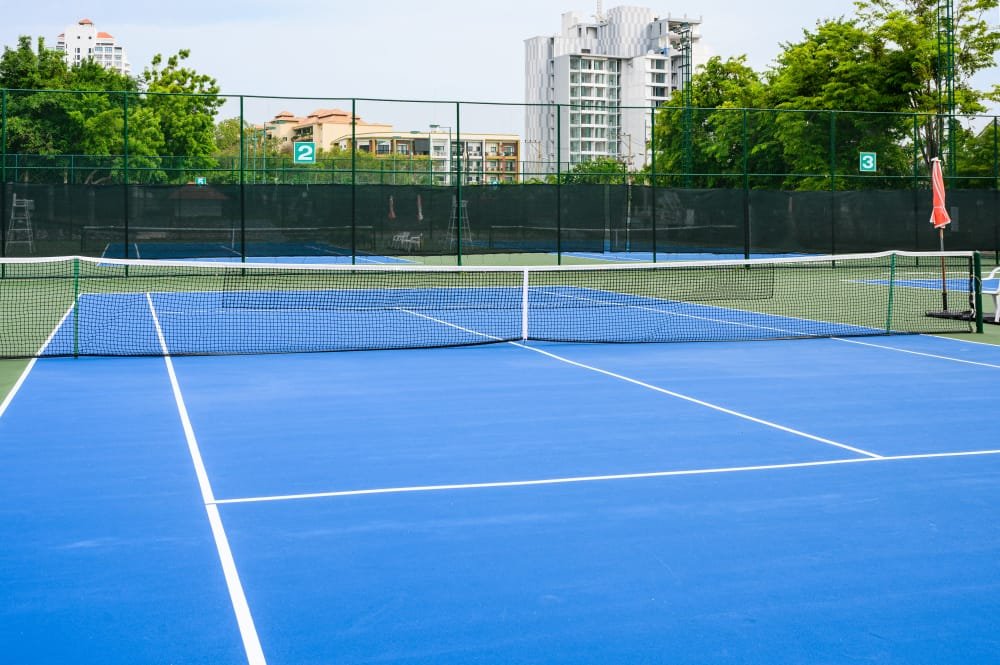
Step 6: Court Markings and Color Coating
After the surface is installed:
- Court lines are marked
- Acrylic coatings are applied
- Surface texture is finalized
Common color combinations include:
- Blue and green
- Blue and red
- Green and green
High-quality coatings improve durability and aesthetics.
Step 7: Tennis Equipment Installation
Essential court equipment includes:
Tennis Posts
Must be securely anchored.
Tennis Net
Should meet regulation height requirements.
Center Strap
Ensures proper net tension.
Court Accessories
Optional additions include:
- Benches
- Umpire chairs
- Ball holders
Quality equipment improves user experience and safety.
Step 8: Fencing and Security
Most outdoor courts require perimeter fencing.
Recommended Height
3–4 meters for recreational courts.
Benefits
- Prevents ball loss
- Improves security
- Enhances user safety
Chain-link fencing is the most common solution.
Step 9: Sports Lighting
Lighting extends court usage beyond daylight hours.
Benefits
- Night play
- Coaching sessions
- Tournaments
- Increased revenue potential
LED sports lighting is preferred because it offers:
- Lower energy consumption
- Longer lifespan
- Better illumination quality
Additional Amenities
Modern tennis facilities often include:
Spectator Seating
Useful for competitions and events.
Clubhouse Facilities
May include:
- Reception areas
- Lounges
- Changing rooms
Parking Areas
Improves accessibility.
Coaching Zones
Supports academy operations and private lessons.
Estimated Tennis Court Construction Costs in Africa
Costs vary based on location, materials, and specifications.
Basic Recreational Court
Approximately:
- $15,000 – $35,000
Standard Acrylic Tennis Court
Approximately:
- $35,000 – $70,000
Premium Tennis Facility
Approximately:
- $70,000 – $150,000+
Features may include:
- Lighting
- Seating
- Clubhouse amenities
- Professional-grade surfaces
Local market conditions and import costs significantly influence final pricing.
Tennis Court Maintenance
Proper maintenance extends court lifespan and protects investment.
Routine Maintenance Includes:
- Surface cleaning
- Drainage inspections
- Fence repairs
- Net replacement
- Crack repairs
Recommended Inspections
- Monthly visual inspections
- Annual professional maintenance assessments
Well-maintained courts can remain operational for decades.
Common Tennis Court Construction Mistakes
Avoid:
Poor Drainage Design
One of the leading causes of court failure.
Low-Quality Foundations
Results in cracks and uneven surfaces.
Inferior Materials
May reduce lifespan significantly.
Inadequate Lighting
Limits court usage and revenue potential.
Ignoring Future Maintenance
Maintenance planning should begin during the design phase.
Conclusion
Tennis court construction in Africa requires careful planning, quality engineering, and attention to detail. From site selection and drainage design to surface choice and lighting installation, every component plays a role in creating a safe, durable, and enjoyable facility.
Whether the project is for a school, residential estate, hotel, sports academy, or private club, investing in proper construction standards ensures long-term performance and value.
As tennis continues to grow across Africa, well-designed courts will play a critical role in supporting athlete development, community recreation, and sports business opportunities. With the right approach, a tennis court can become a lasting asset that serves players and communities for many years while delivering strong returns on investment.